
Gini (Coefficient) in the Housing Machine
Population growth drives housing demand but the income gap decides how fast home prices rise

Home values have surged over the past decade, but appreciation varies significantly across markets. In general, economic theory would suggest that metro areas with stronger housing demand experience faster home price growth than metro areas with lower demand. However, this analysis finds that regional income inequality is an important driver of home price growth and has accelerated housing affordability challenges in high-demand markets.
To evaluate the role income inequality plays in housing affordability (specifically homeownership affordability), I analyzed population growth and home values in the largest 100 metropolitan areas in the U.S. (representing nearly 80% of the U.S. population). Using Census data from 2016 and 2024, I examined the change in median home values based on two indicators:
Strength of Housing Demand: Measured as the percentage change in population between 2016 and 2024. Metro areas with “high” demand are defined as those where population growth was higher than the median for the top 100 metros (+6.7%). “Low” demand metros are those with population growth at or below that median.
Level of Income Inequality: Measured by the baseline 2016 Gini coefficient. Metros with “high” income inequality are defined as those with a Gini coefficient above the top 100 median (0.4647), while “low” income inequality metros sit below that threshold.
The primary outcome variable was the percentage change in median home value over the 2016 to 2024 period.
This relatively simple analysis suggests that income inequality has a profound impact on real estate, effectively bifurcating market outcomes based on the velocity of local housing demand.
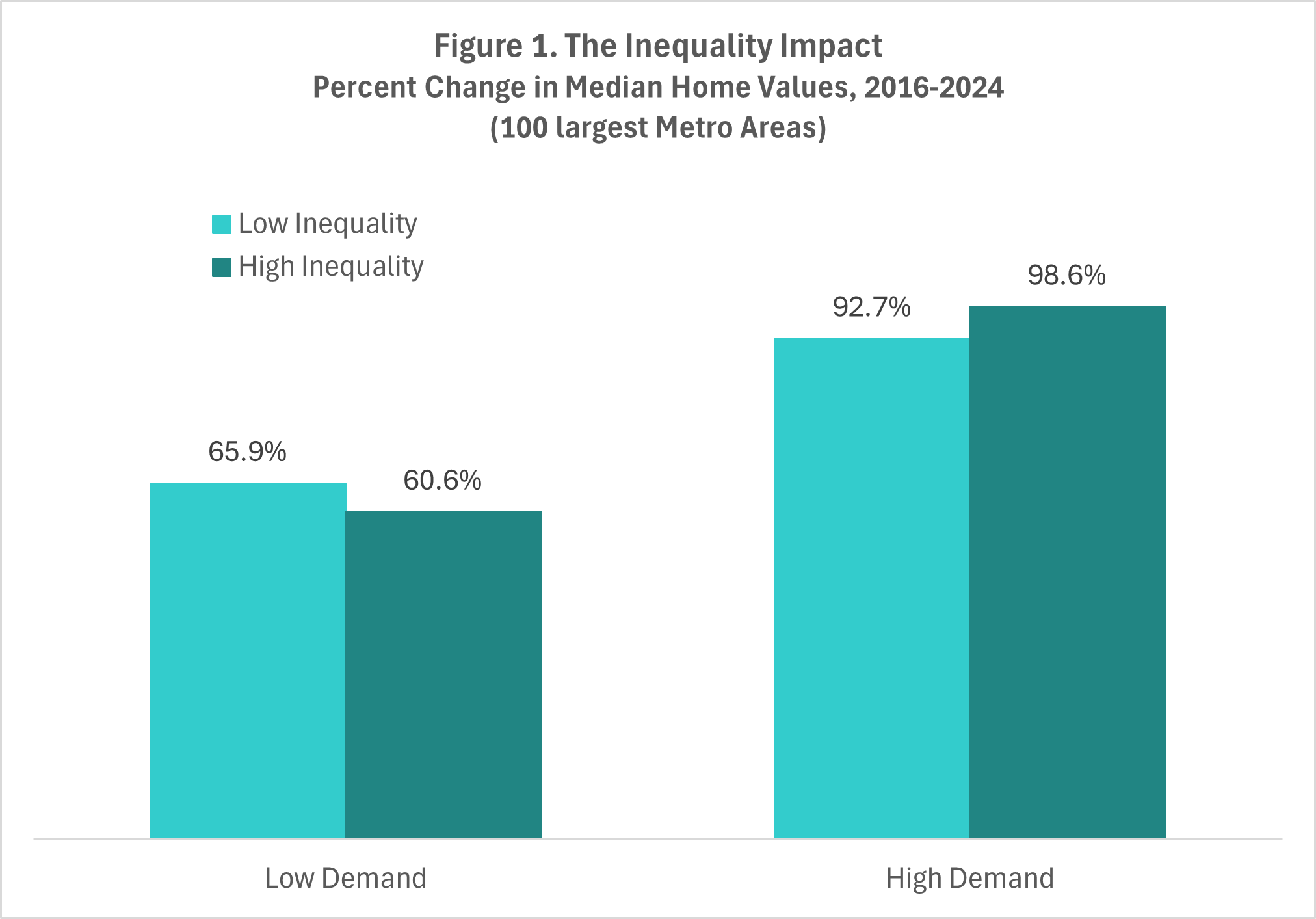
Income inequality serves as an accelerant in high-demand markets.
When there is strong demand for housing in a highly unequal metro (e.g., Tampa, Charlotte, Dallas), income concentration acts as an accelerant to home price appreciation. Because housing supply is inelastic in the short term, affluent in-migrants and high-income local buyers can aggressively outbid the rest of the market. In these markets, the median home value increased by 98.6% between 2016 and 2024, compared to a 92.5% increase in other high-demand markets with less income inequality (e.g. Boise, Salt Lake City, Raleigh).
Income inequality serves as a brake in low-demand markets.
Conversely, when there is relatively low demand, high income inequality acts to slow home price appreciation. Without an influx of outside capital, transactions depend entirely on local residents. In places with high income inequality, wealth is trapped at the extreme top, and these wealthy households will only account for a very small part of potential home sales transactions. Local buyers generally lack the financial capacity to bid up home prices. In low-demand, high-inequality metros (e.g., Boston, Memphis, Miami), the median home value increased by 60.6% between 2016 and 2024. By contrast, in slow-growth, low-inequality markets (e.g., Minneapolis, Syracuse, Albuquerque), where a distributed middle class provides a more robust and self-sustaining homebuying population, home values increased faster, by 68.5%, over the same period.
(Note: Because this analysis examines the nation’s 100 largest metro areas, these findings reflect trends in major urban centers. This interaction between demand and inequality may not play out as consistently in smaller, secondary real estate markets.)
Policy Implications
In high-demand, high-inequality metro areas, blanket policies designed to increase supply will be insufficient on their own to help ease housing affordability challenges. When wealth and income are concentrated, these high-income buyers can easily absorb new inventory and continue to push home prices higher. In these places, policymakers cannot simply pump more fuel into the supply engine; they need to deploy a dual set of interventions that combine both supply-side incentives (e.g. blanket upzoning) and income-targeting (e.g. inclusionary zoning) to help improve affordability and help protect local residents from displacement.
Alternatively, in low-demand, high-inequality metro areas, the policy priorities should not be increasing density but rather investing directly in the local economic base. Slower price growth in these markets is not a sign of healthy affordability, but rather a symptom of an economy operating below potential. Policymakers in these low-demand, high-inequality regions should focus on the demand side, including initiatives that expand local middle-class employment and offer targeted down-payment assistance.